COLLEGE NATIONALS 2026 PREVIEW
Boogity, boogity, boogity. College Nationals is right around the corner.
The most anticipated event of the year for every college roundnet athlete has arrived. Months of practices, road trips, sectionals, workouts, fundraising, and late-night reps now culminate into one final weekend. Every point matters. Every line matters. One program will leave Charlotte crowned the 2026 Division I National Champion.
Before the first serve goes this weekend, let’s take a look back down the road that brought us here.
Nearly a year ago, Indianapolis hosted the 2025 College National Championship. The last time many of these programs saw one another was on the biggest stage. Virginia Tech emerged as Division I National Champions, but the event itself felt bigger than just the results. The competition was electric, the atmosphere unmatched, and the tournament execution set a new standard for what college Roundnet could become. For many players, coaches, and fans, it felt like a glimpse into the future of the sport.
That future, however, suddenly became uncertain.
Indianapolis marked the final self-operated collegiate event run by Spikeball after years of leading both the professional and collegiate scenes. When the news spread throughout the community, uncertainty followed closely behind. Questions emerged surrounding scheduling, leadership, rulesets, and the future of the college season itself.
What followed was one of the most important moments in college roundnet history.
Players, coaches, organizers, USA Roundnet representatives, and Spikeball leadership gathered on an 80-person Zoom call to chart a path forward. From that meeting, the USAR College Roundnet Board was formed as a collaborative effort dedicated to ensuring the season survived and continued to grow. From organizing the spring calendar to establishing tournament standards and rulesets, the community stepped up to preserve the game they loved.
Now, that journey reaches its climax in Charlotte, North Carolina.
The stage is set with 18 Division I teams, 17 Division II teams, and 10 Open Individual teams. A total of 302 collegiate athletes are competing for a national title.
Programs built over years of commitment, recruiting, leadership, and culture now collide for one final tournament.
And the road to a championship is absolutely loaded.
THe favorites
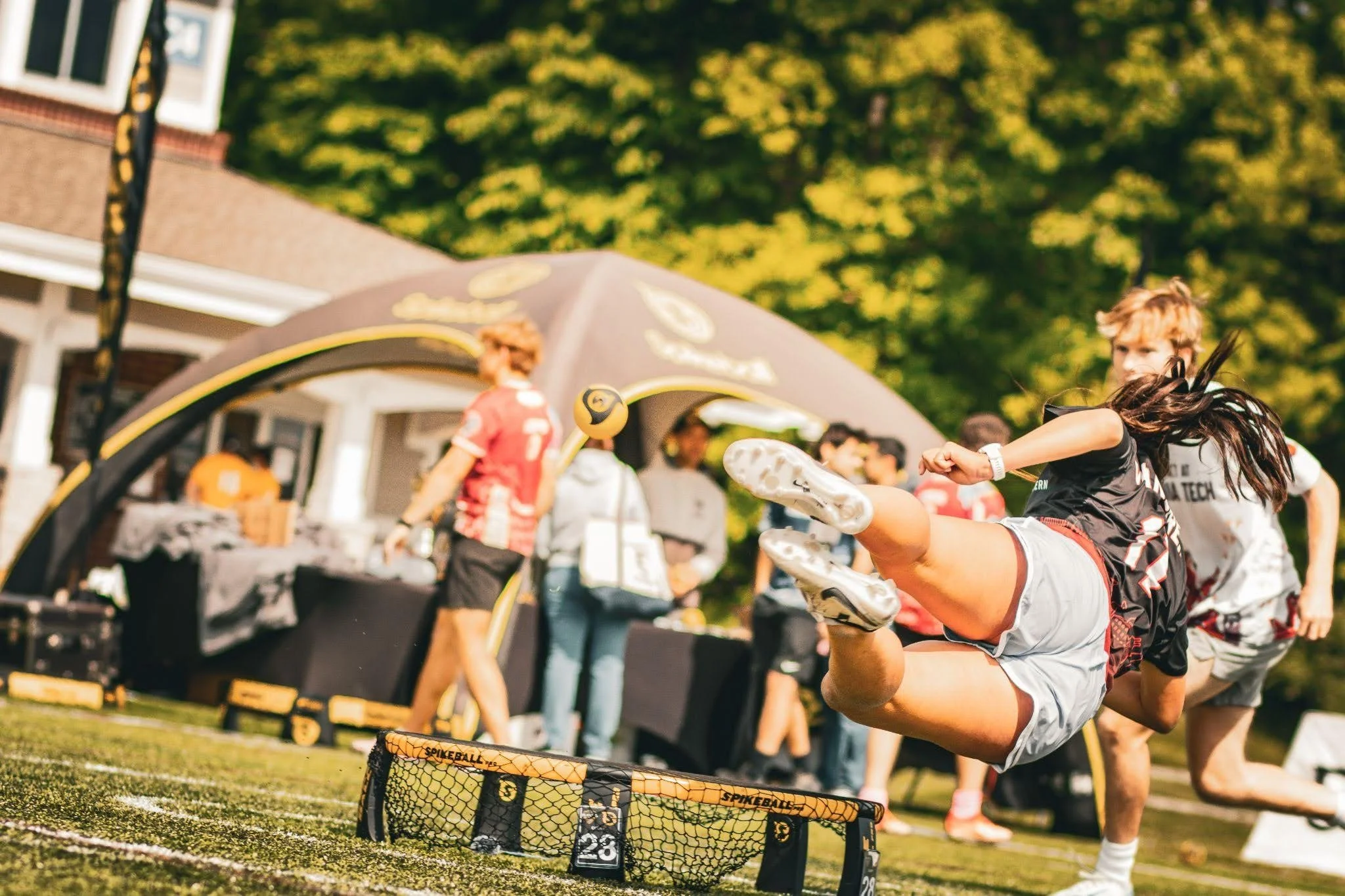
Photo Creds: @jacobnarayan_roundnet
The number one overall seed entering the weekend is Northeastern, a program that has hovered at the top of college Roundnet for years. After back-to-back runner-up finishes in 2024 and 2025, along with a Final Four appearance in 2023, Northeastern enters Charlotte with both experience and unfinished business.
A massive piece of that success belongs to longtime coach Sunny Gu, whose years of player development have transformed Northeastern into one of the premier programs in the country. Several of those athletes now rank among the best players in the collegiate and professional scenes.
Leading the charge are All-Americans Abby Lamontagne and Malia Wanderer, who currently sit sixth and tenth respectively in the USAR ELO rankings. The duo has been instrumental in all three of Northeastern’s semifinal appearances. They now enter their final collegiate season searching for the one accomplishment still missing: a national championship.
Northeastern’s women’s program has dominated headlines, but their men’s depth may be what finally pushes them over the top. With five Gold-level USAR players throughout the lineup, they possess one of the deepest rosters in the tournament. Their A line features Andrew Nee and Sam Diani, while Mitch Whelan and Jackson Biggs headline the B line. Matt Wallach is paired with Abby to play in mixed competition as well.
If there was ever a year for Northeastern to finally break through, this is it.
But no contender enters Charlotte with more motivation than Penn State.
Last season, Northeastern eliminated Penn State in a dramatic quarterfinal matchup that ended 2-3, with nearly the entire tournament crowd gathered around the B net for a winner-take-all Game 3. If that heartbreak wasn’t enough, the rivalry intensified again earlier this spring at the Albany Sectional. The matchup went the distance and it came down to the C line. And yet again, Northeastern persevered, this time winning the deciding game 27-25.
Penn State now returns with revenge squarely on its mind
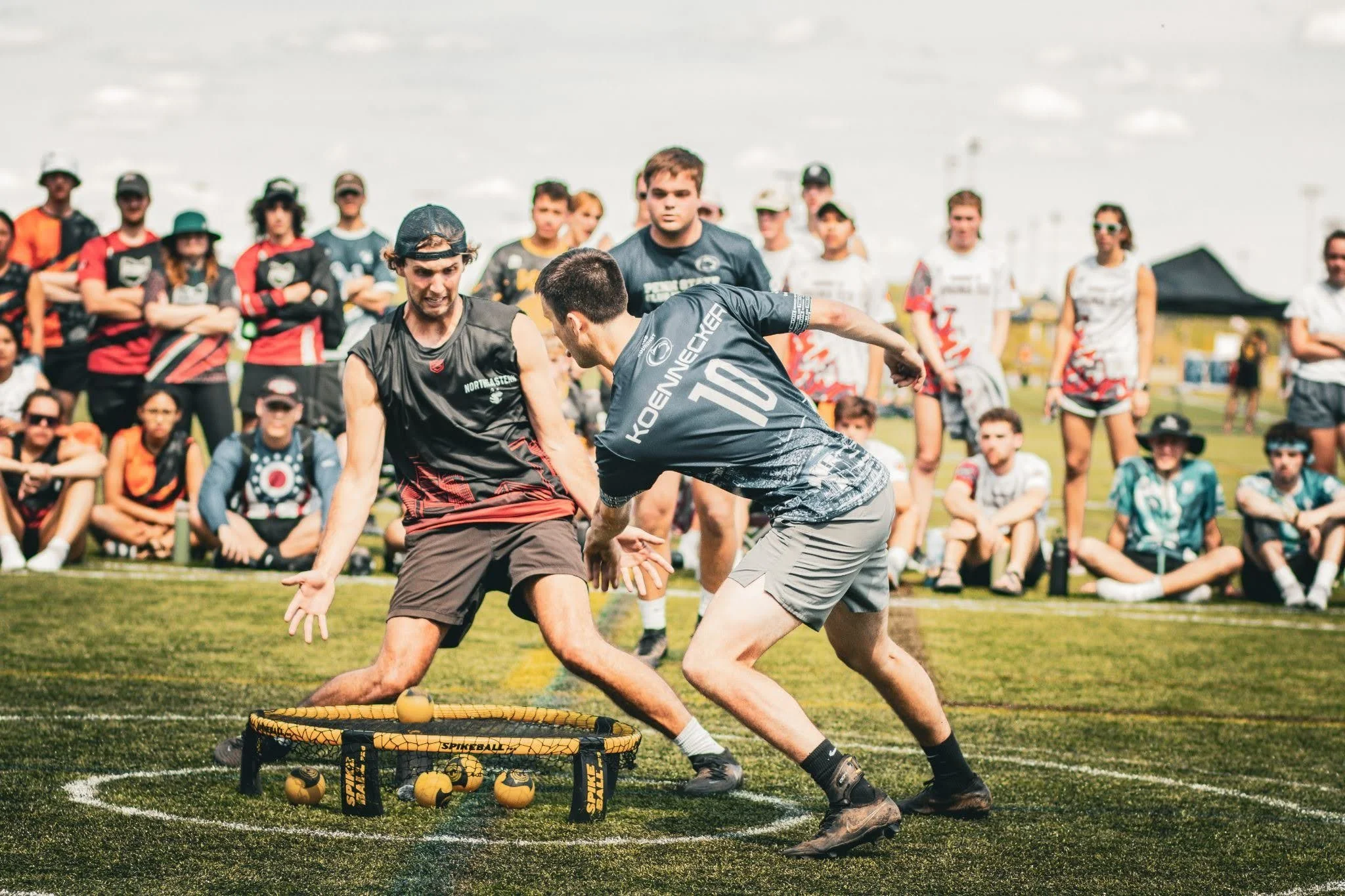
Led by club president and All-American Jake Hurst, Penn State combines elite athleticism with a contagious energy that few programs can match. Their chemistry, depth, and confidence have made them one of the most dangerous teams in the field, with their only major stumble coming against defending national champion Virginia Tech at the East Bay Spring Sectional.
Speaking of Virginia Tech, the defending champions are back, and history is on the line.
No Division I program has ever repeated as national champions.
Virginia Tech returns reigning Female College Player of the Year Kathleen Phan alongside Breakout Player of the Year Jaxon Gonzalez. Gonzalez has rapidly developed into one of the most explosive athletes in college Roundnet, pairing elite defense with dynamic hitting. Alongside Jonathan Esposo, the duo has become one of the most feared partnerships in the division.
However, Virginia Tech enters nationals with one significant change. Kathleen Phan will no longer compete alongside longtime partner Brooks Weeks, a pairing that helped define Virginia Tech’s success over the past two seasons. Replacing that chemistry will be one of the key questions surrounding the defending champions this weekend.
Still, championship pedigree matters, and Virginia Tech has plenty of it.
Another perennial powerhouse looking to reclaim the throne is Georgia.
The 2019 national champions continue to remain among the elite programs in college roundnet, finishing third last season after knocking out Cal Poly in the 4th place game. At the center of Georgia’s consistency is coach Ben Landes, whose leadership has provided stability and long-term development in a collegiate environment constantly rotating players every four years.
Georgia once again enters Charlotte loaded with talent.
Returning Men’s College Player of the Year Peyton Stack headlines the roster alongside Gold-level player Andrew Yancey. Their B line is equally dangerous, featuring Isaac Mixon and Nate Von Der Sitt. On the women’s side, Savannah Obert and McKenna McKean recently competed at the USAR Worlds Individual Camp in Atlanta, further solidifying Georgia as one of the most complete programs in the country.
Out west, Cal Poly arrives with revenge on its mind after last season’s fourth-place finish.
The Mustangs have rapidly become one of the most exciting programs in the sport, thanks in large part to the emergence of Jake Woolley. Woolley recently stormed onto the professional scene with a runner-up finish in Dallas and a strong showing at the Los Angeles NATS event alongside Reece Greer. The duo will split onto separate lines for Nationals. A strategic move that could maximize Cal Poly’s overall depth and championship ceiling.
Do not be surprised if Cal Poly makes a serious run at the title.
Another major contender comes from the Midwest in Michigan State.
After falling decisively to Georgia in last year’s quarterfinals, Michigan State has spent the entire season responding. They captured victories at both of their sectional events and did not drop a single game at their most recent sectional tournament.
Led by Jack Drouare and Korbin Thompson, Michigan State possesses both experience and momentum entering Charlotte. Their women’s depth is equally impressive thanks to standout twins Katie Hansen and Natalie Hansen, giving the Spartans one of the more balanced rosters in the field.
Beyond the title favorites, several other programs are more than capable of disrupting the bracket.
NC State, led by coach Tommy Drake, features top players like John Buchanan and Rosie Craven. Purdue secured its first-ever power pool bid behind club president Henry Cheung. UNCW brings dangerous talent in Jake Dooley, Noah Koeptic, and Polk Denmark. UConn features fan-favorite NATS duo Snowfall, Jacob Lamontagne and Sam Panek, alongside five additional Premier-level players. And if spectators simply want to watch elite-level roundnet, few players command attention quite like Jacob Summers leading Liberty.
What about d2?
With some programs unable to field a full Division I roster, Division II enters Nationals absolutely loaded this year.
What was once viewed as a developmental division has quickly become one of the deepest and most unpredictable brackets in Charlotte. Several teams entering D2 have already proven they can compete at a D1 level throughout sectionals, creating a field where experience and top-end talent may matter more than division labels.
One of the biggest names entering the weekend is former 2021 National Champion and top pro player Tyler Fernandez, suiting up for Baylor. Any time you have a player with that level of experience entering the bracket, expectations rise immediately.
RIT enters with one of the more unique stories of the season. After forming a co-op roster with Rochester and taking third place at the Northeastern Sectional, the partnership eventually dissolved, sending the program into D2 competition. Despite the change, RIT remains dangerous behind USAR Gold player Riley Nassour, who gives them a shot to win it all.
And they’re not alone.
Programs including UCI, Pitt/Carnegie Mellon, UTK, UMD, and Montana State all previously fielded Division I squads during sectionals before landing in the D2 bracket for Nationals. That experience alone makes this one of the strongest Division II fields we’ve seen.
Add in proven programs like Georgia and Michigan State, both of whom bring strong development systems and competitive depth every season and suddenly there are very few easy paths through this bracket.
And of course, you can’t talk about Division II without mentioning the defending national champions: Penn State.
One notable change coming into this year’s D2 competition is the addition of a required women’s player on every roster. What was previously three open lines has evolved into a format requiring female representation, with players eligible to compete on any line as long as line strength follows the traditional A > B > C order.
Open Individual
And it’s back. To give clubs the opportunity to send more athletes to College Series events, the Open Individual division returns to Nationals. The division creates a competitive outlet for roster selection while making sure any player who wants to represent their school still has the opportunity to compete. Not every club can field full D1 or D2 teams, and Open Individual helps keep the barrier to entry low while allowing more athletes to experience the sport we all love.
Expect plenty of energy, hungry players, and competitors with something to prove.
And that’s what makes College Nationals special.
The sport thrives on unpredictability. Upsets are inevitable. Momentum swings happen constantly. Crowds form around deciding games. Players leave everything they have on the field for the schools and teammates behindside them.
College Roundnet is full of screaming, smiles, tears, chaos, and nonstop energy.
So now the question remains:
Who will take it home?
Tune into live streams here:2026 College Roundnet National Championship | Primary Live Coverage | Day 1
See full lineups here: https://docs.google.com/spreadsheets/d/10TEJZj3oFXAXIbtJIt5Ks9EXj1we5wHbU7URexSab_A/edit?gid=1883012986#gid=1883012986
Copy of Schedule here: Copy of Nattys Format and Schedule - Google Docs
Nominate for College Roundnet Awards here: https://forms.gle/x6vsQQyqXsWPE2LP9